Showing posts with label grottesca. Show all posts

Monday, February 4, 2013

I'll Show You Mine, If You Show Me Yours [Part I]

Wiley Purkey
Well, there's been such a huge response that I'm going to be making this into a series of posts. I'm getting palpitations thinking about all the money I could blow on the books I don't have here. 

Artist Wiley Purkey submitted this great selection. The period in American Art around the 1920s is fascinating to me. Artists reacted in different ways to the mechanization of Industry. Disenchanted by the industrialization of America, the likes of Edward Hopper captured the sense of urban isolation felt by so many. An intensely private man, and a lifelong celibate, he painted this America from the inside. The Regionalists, on the other hand, represented an artistic belief that rural America and back-to-basics labor off the land could replace urbanization and the factory-line. Illustrators Howard Pyle, and his student N.C. Wyeth, espoused a similar (called Brandywine) Romanticism of New England. Burchfield portrayed similarly heightened visions of the American landscape, turning his back on the urban world of his old friend Hopper. Andrew Wyeth was called a 'Regionalist' by his detractors, but he painted a "Pennsylvania [that] seems to groom itself with a cold gray tongue" [source]. This was not quite the Romantic regionalism of his contemporaries. Wyeth's was darker, more private. A rural version of Hopper's urbanity. Impressionists in Winter is, in my opinion, the best of Impressionist art. When the artist's palette is reduced to almost nothing, there's a reliance on composition and value that is almost Japanese at times. Not surprising then to see a copy of Whistler's beautiful Etchings here too.

Book Links: 

Andrew Wyeth
James Montgomery Flagg
Maxfield Parrish

Theresa Cheek, of Art's The Answer!
Art's The Answer! is the fantastic blog written by Theresa Cheek, who clearly has a passion for the decorative arts, and for sharing all she comes across. Konemann does a great job of bringing out large format, lavishly photographed, and reasonably priced books on architecture and ornamentation. This is just a tiny selection of Theresa's vast collection on a huge variety of subjects. Be sure to check out her blog. And just peeking in on the far right is a book that's very popular with my West Coast friends, called Ca'toga. It's about the Dali-meets-Baroque-meets-Antiquity estate of Venetian artist Carlo Machiori. I've yet to come across a book dedicated solely to the painted surfaces of Versailles, but I'm sure it's out there. Until then, I love to browse through books such as Splendors of Versailles, for snippets of Oudry's landscapes and Fontenay's flowers and vases. Incredible stuff.

The St. Laurent book is a rare glimpse into the decor stylings of one of the 20th Century's very best designers. Jacques Grange features heavily in the selections, and though the lavishness of the homes becomes makes me feel a bit claustrophobic after a while [I want to run off and live in Wyeth's cabin by the end of the book], it's well worth the investment.

Ca'toga
The Private World of Yves St. Laurent & Pierre Bergé
Splendors of Versailles

Karen
The 1920s once again putting on a strong show, this time from a European design perspective. Karen of Chicago's Des Travaux sent us this great shot, showing some of the stalwart classics we all know and love, along with some real treasures. Jansen Furniture is a great book about the powerhouse Paris-based design company, who's ebony and ivory geometrical inlay doors are a real treat. I narrowly missed the opportunity to create replicas of those doors once. Jean Dunand is also a master interior designer, and perhaps the greatest lacquer artist of the Art Deco period. I've downloaded any image of his incredible standing screens that I can get my hands on. Paul Poiret is the creator of the most beautiful dresses ever made. Click the link and you'll see what I mean. It's tragic that he was ruined completely by WWI and made bankrupt. As someone who'd backed myself into a rarified corner of decorative painting, I'm all too aware that tough times reveal the precariousness of this business. Elkins, on the other hand, thrived, and by the end of her illustrious career had created a huge number of interiors for the West Coast glitterati. And what I wouldn't give for that copy of Antonio Basoli's stunning designs.


Art Instruction books that I see on a lot of shelves (including my own):

The Art of Faux (P. Finkelstein)
Handbook of Painted Decoration (Y. Guegan)

Okay, gotta go. Keep sending them in! I'll upload more shots when I have a chance.

Wednesday, January 30, 2013

Engravings of Raphael's Designs for the Vatican Loggia


This should quicken the pulse of at least a few ornament nerds out there. I know I'm not completely alone. Yeah, you know who you are. This is my second post on the subject of the extremely rare full color set of engravings, hand-painted in gouache, of Raphael's incredible designs for the Vatican Loggia.

I posted an enormous set with 277 large format details, taken directly from the original engravings, on my Flickr page. You won't find these anywhere else, you lucky lucky bastards. Except if you happen to own one of the only three full surviving color sets, of course. In which case I hate you.

For information on the engravings themselves, and background to the Vatican loggia, see this earlier post on my blog.

Enjoy!


Wearing black ski masks, and suspended from the ceiling so as not to trip the alarms
Here's an oblique detail showing the beautiful gilding on the Noah's Ark panel

Friday, March 2, 2012

Raphael Loggia Ornament


What's the most fun you can have without a King-sized bed and a rubber chicken? Yep, you guessed it: I just spent a day studying an original set of hand-painted engravings from 1770 of Raphael's designs for the painted ornament for the loggia at the Vatican.

It took three of us just to carry the first volume onto the viewing table. This thing looked like the Queen Mary hoving into view. Raphael himself could have delivered it on a unicorn and I'd be no more impressed. It was the most awesome object I've ever seen.


Three volumes, (the first of which measured about 24" x 36"), meticulously engraved, and subsequently painted in vibrant gouache of Raphael's panel, ceiling and pilaster designs for the Vatican in a riotous mixture of earthy fauna, gauzy maidens, beardy gods and grotesque ornament of every imaginable type.


Can somebody please explain the Universe to me, because I'm a little confused: How is it that one of only three complete sets in the world of these spectacular engravings can sell in November of last year for only $25,000, when Damien Hirst can sell horse manure for a million? It makes me so mad. And why am I finding out four months too late? I would have gladly cashed in my daughter's college fund if I'd known.


"The loggia, or colonnaded porch, on the second story of the Apostolic Palace is one of the Vatican’s most remarkable art treasures; its decoration, designed by Raphael (1483—1520) and executed by his workshop in 1517- 1519, epitomizes the spirit of the Italian Renaissance in its synthesis of Christian and classical themes. The thirteen square vaults of Raphael’s loggia each contain four frescoes of scenes from the Bible, from the Creation to the Last Supper." [source] 


Noah's Ark scene from the Vatican loggia...
... and the same scene as depicted in the set of engravings
"These splendid, large-size copperplate engravings, from the suite Le Loggie di Rafaele nel Vaticano (Rome: 1772-77), after the celebrated frescoes by Raphael in the loggia of the Vatican, are scarce, with OCLC recording only two complete copies in libraries worldwide.

"The Raphael Loggia consists of thirteen arches forming a gallery sixty-five meters long and four meters wide. Its construction was begun by architect and painter Donato Bramante in 1512, under Pope Julius II and was completed by Raphael under the reign of Leo X. Raphael began work on the frescoes in 1517.


"The plates, designed by P. Camporesi, G. and L. Savorelli Teseo and engraved by G. Volpato (1733-1803) and G. Ottaviani (1735-1808), depict, in a vibrant color gouache, the pilasters, paneling, ceiling panels and two doorways with floral, figural and architectural motifs. Where human figures in the original frescoes were compromised by weathering and erosion, engravers Volpato and Ottaviani replaced them with elements from the Vatican tapestries designed by Raphael.


"While Raphael's Vatican frescos were admired in their time, they were ultimately overshadowed by the work of Michaelangelo until the Neoclassicists of the eighteenth and nineteenth centuries rediscovered the Renaissance, and Raphael earned his place as the era's greatest artist of them all.

""Raphael is categorically the greatest painter of the last millennium, and the Loggia is his most significant legacy," says Antonio Paolucci, director of the Vatican Museums and esteemed art historian.


"And yet the Loggia is the least known of Raphael's works. Millions of visitors to the Vatican Museums pass by it every year, but cannot go inside. Looking from Saint Peter's Square, it is in the second of the three glassed-in hallways across from the building in which the pope resides. When it was constructed, in the early part of the sixteenth century, it overlooked a garden. The thirteen arches of the Loggia frescoed by Raphael were not enclosed in glass until the nineteenth century. Originally, they were open to the luminous Roman sky, which made their colors even more brilliant" (Sandro Magister, Chiesa Espressonline)."

[source]

It has been notoriously difficult to find any images of Raphael's loggia work - the fact that the loggia are closed to the public and sealed behind glass has not helped - but Abbeville Press has published what looks like a fine book on the subject.


Monday, February 14, 2011

Ornament Drawings

The best drawing I have found of the structure of the acanthus scroll
These incredible details are from a huge (13 3/4" x 9") three volume set of prints engraved in 1872 by C. Claesen entitled Spécimens de la décoration et de l'ornementation au XIXe siècle. The amount of work involved In the drawings alone is staggering, let alone the time spent carving them out of stone or wood, casting them in iron, gilding them, painting them on panels, or sculpting them in clay and casting them out of plaster. These guys must have been just churning this stuff out. It's no wonder they got a little weird every now and then, like: What exactly are these two monkey people up to?


The quality of the draughtsmanship in every engraving is just superb. I'm giving you a close up view here, hoping that you'll enjoy these as much as I do. They are exquisite examples of how to draw ornament.

I posted a set of 187 images from the book here, on my Flickr page. Don't forget to click the largest size before you download.


Sunday, February 6, 2011

Antique Map Cartouches


I love antique maps. The combination of gorgeous ornament, the romantic whiff of aging prints, and magic of Terra Incognita is a winner. It reminds me of the apocryphal ad placed by the legendary Ernest Shackleton looking for a crew:
 "MEN WANTED FOR HAZARDOUS JOURNEY. SMALL WAGES, 
   BITTER COLD, LONG MONTHS OF COMPLETE DARKNESS,
   CONSTANT DANGER, SAFE RETURN DOUBTFUL. HONOR AND
   RECOGNITION IN CASE OF SUCCESS."
I've never been one to let the truth get in the way of a ripping yarn [this ad may never have been placed], and Shackleton's voyage South is by far the rippingest of yarns I've ever read. It's that "safe return doubtful" part that gets me every time. I love the idea of these hard-men heading into the blank of a map with naught but a pouch of tobacco and dead reckoning.

On a different note, there was an article in the New Observer recently about the death of blogging; basically saying that any idiot with a 'Sarah Palin' Google Alert and a keyboard can regurgitate other peoples work into a blog entry. Well here's yet another uncreative blog post by me. Other people's work again.

It's always been the case with me that I try to write the blog I wish I had found when I was starting out. Lots of large images and little commentary. So I'll skip the pithy one-liners and the wiki-links this time and just present the work itself, because I think it's beautiful.

Rather than choke the inbox of the few faithfuls who subscribe to this blog, I'm posting just a couple out of my collection of cartouche images here. The rest are here, on my Flickr page.


Wednesday, January 12, 2011

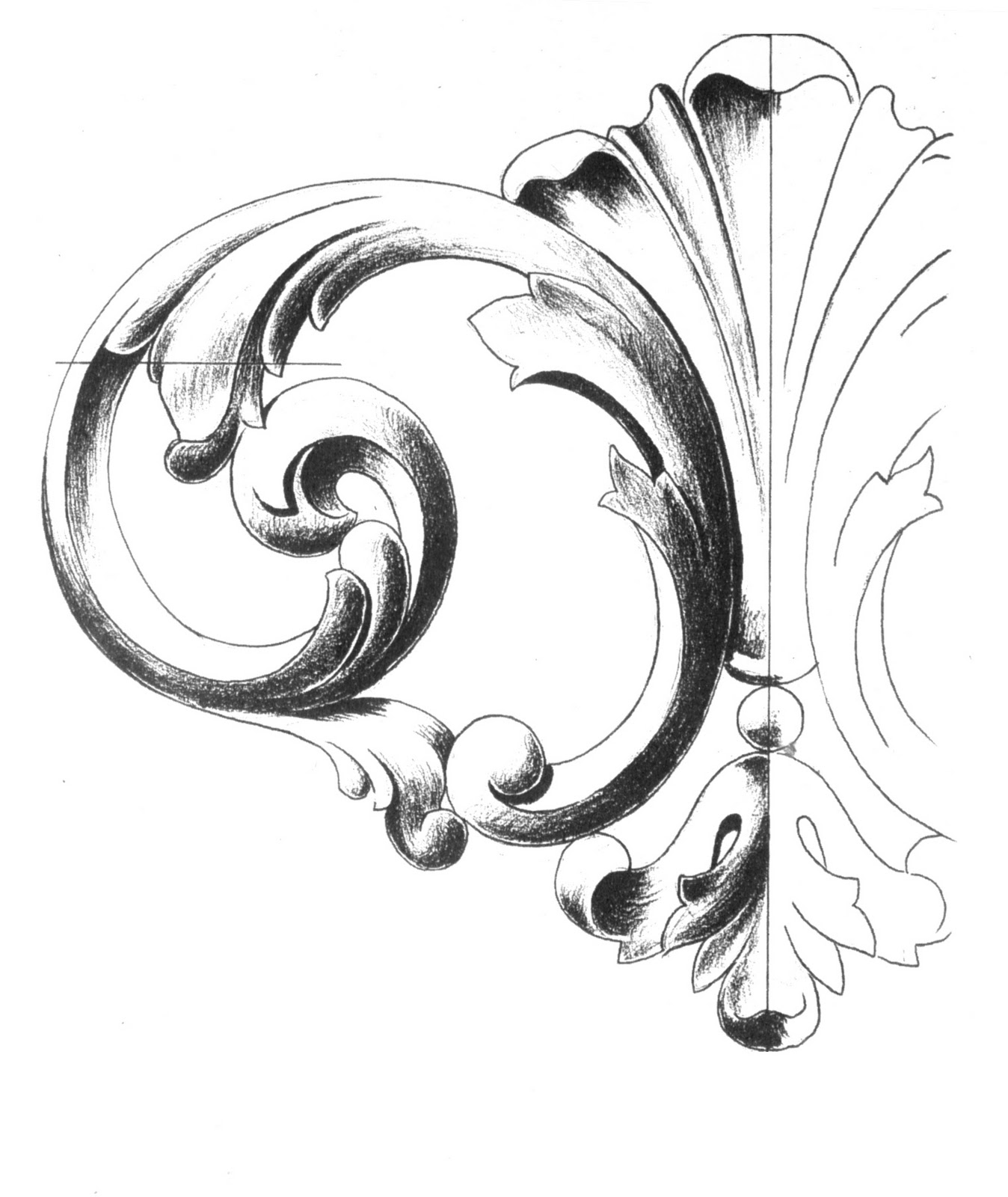
How to Draw the Acanthus, Part III


'How to draw the Acanthus' is a perennial topic with a rich history. I covered some points in Part I and Part II, and am presenting these drawings as a further aid to drawing the acanthus scroll and related ornament. Though most suitable to hand-carving, they have a simplistic contour and sharp contrasts of light and dark which lend themselves well to an understanding of painted trompe l'oeil and the study of simple form.  They are not as ornate as say, the drawings of LePautre, which are very elaborate and detailed, but that also means that they're less confusing to study. I personally find them to be a little heavy for trompe l'oeil or grottesca, but there are some elemental ornate forms here that are really nicely treated.

And the truth is they are closer to what one might expect to paint in a real-world job situation. As gorgeous as the drawings of LePautre are, modern taste seems to tend towards economy of ornament - if we see ornament of this nature at all any more.

All Illustrations this article: "Motifs Ornementaux: Sculptures Sur Bois" [Editions H. Vial]